

Your Weekly Deposit
The World Just Changed. Here's What It Means for Your Money.

Hey beautiful,
I want to start today’s Weekly Deposit differently than I normally do. I want to start with a breath.
Because I know you’ve been watching the news. I know you’ve seen the headlines — the explosions in Tehran, the missiles flying across the Middle East, the oil prices spiking, the market dropping. And I know that for many of you, your first instinct isn’t “how does this affect my portfolio?” — it’s “is the world okay? Are we okay?”
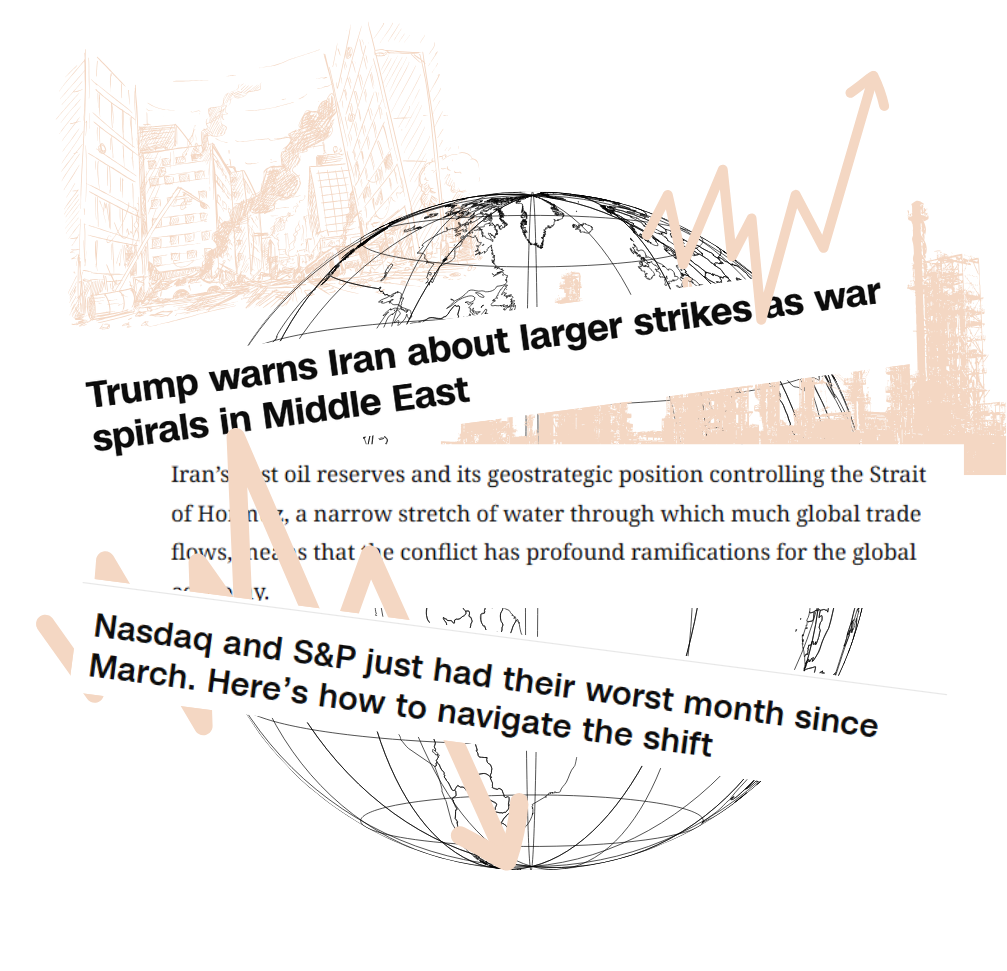
So let’s acknowledge that first: what’s happening in Iran right now is not just a market event. It’s a human tragedy unfolding in real time. Hundreds of civilian lives lost. Families torn apart. A region destabilized. My heart holds space for all of that.
AND — because this is a financial education space and that’s why you’re here — we’re going to talk about what this means for your money. Because the two things aren’t mutually exclusive. You can grieve for the world AND protect your family’s financial future at the same time.
Let’s get into it.
THE FULL STORY: WHAT ACTUALLY HAPPENED
On Saturday, February 28, the U.S. and Israel launched a coordinated military operation — dubbed “Operation Epic Fury” — striking Iran’s military infrastructure, leadership compounds, and nuclear-related facilities across multiple cities.
By Sunday morning, Iranian state media confirmed: Supreme Leader Ali Khamenei — who had ruled Iran for over 36 years — was killed in the strikes. Iran formed a temporary 3-person leadership council and declared 40 days of national mourning.
Iran retaliated within hours — launching waves of missiles and drones across the region. Targets included Israel, Bahrain (U.S. Navy 5th Fleet HQ), Qatar (LNG production facilities), Saudi Arabia (Ras Tanura refinery), Kuwait, the UAE, Jordan, and Iraq. Hezbollah fired rockets at Israel for the first time since November 2024.
- Four U.S. service members have been killed. President Trump says “there will likely be more.”
- Israel has mobilized 70,000 reservists.
- Trump says the operation could last 4–5 weeks. Combat operations are continuing “at full force.”
- Jordan has closed its airspace. Dubai airport was temporarily impacted.
As of Monday, March 2 — Day 3 — this is a widening regional war with no clear end in sight. This is not background noise. This is a market-moving, economy-shaping event that demands your attention.
THE OIL SHOCK — THE MOST IMPORTANT THING FOR YOUR FINANCES
Why the Strait of Hormuz Matters to Your Wallet
The Strait of Hormuz is a narrow waterway between Iran and Oman at the mouth of the Persian Gulf. Through it passes approximately 20% of the world’s oil — 15 million barrels per day — and a significant share of global LNG supply. It is one of the world’s most critical energy chokepoints.
Right now, the strait is effectively shut down. Iran has declared it closed. Tankers are being attacked. Major shipping company Maersk has suspended all crossings. Insurers are refusing war risk coverage. Three tankers have already been struck.
The Numbers as of Monday Morning:
- WTI crude (U.S.): +6.5%, approaching $71/barrel — highest since last summer
- Brent crude (global benchmark): +9%, briefly hit $82 before settling near $79
- European natural gas: surged 20–50% after Qatar halted LNG production
- Oil had already risen 17% this year before the weekend’s escalation
What This Means for Your Daily Life RIGHT NOW
Gas prices at the pump are expected to rise 10–30 cents per gallon within days. Some individual stations could see jumps of up to 85 cents per gallon. Retail gas prices move approximately 2.5 cents for every $1 change in crude oil — and crude just moved $5–7.
For a family filling up twice a week, this could mean an extra $50–$100/month out of your pocket. Budget for this NOW before it hits.
And it doesn’t stop at the pump. Energy costs are embedded in food transportation, manufacturing, and shipping. Prolonged disruption builds inflationary pressure across the entire economy.
The $100/Barrel Line in the Sand
Most analysts agree the current spike is manageable if oil stays in the $75–85 range and the conflict is relatively short-lived. Goldman Sachs noted that only a “severe and sustained” disruption would significantly impact global growth.
But if oil breaks above $100 and stays there — which several analysts say is not off the table if the Strait stays closed for weeks — that changes the entire economic story. At $100+, the Federal Reserve’s rate cut plans likely get shelved entirely. Consumer spending gets squeezed. Corporate margins compress. The market re-prices for a much harder environment.
$100/barrel is your watch number this week.
THE STOCK MARKET — PANIC OPEN, CALM BY NOON
When markets opened Monday morning:
- S&P 500: dropped 1.2% at its low
- Dow Jones: fell nearly 600 points at the open
- Nasdaq: fell 1.6%
- Europe’s Stoxx 600: fell 1.6%
- Japan’s Nikkei: dropped 1.35%
And then... the dip buyers showed up.
By late morning, the S&P 500 turned positive. The Nasdaq climbed +0.5%. The Dow was nearly flat.
Why? Because Wall Street has seen this movie before. History shows that markets tend to recover relatively quickly from geopolitical events — even major conflicts. This is a critical lesson: market volatility during a crisis is normal. Selling in a panic is how ordinary people lose wealth. Staying invested — or buying more — is how wealth is built.
What This Means for You By Age
Ages 25–35: Stay the Course Completely
You have 30+ years of compounding ahead of you. Market volatility during your accumulation phase is not a threat — it’s a gift. It means you’re buying shares cheaper through your automated contributions. Do NOT pause your retirement contributions. If anything, consider increasing them.
Ages 36–45: The Strategic Sweet Spot
This is an opportunity for thoughtful portfolio review. Are you overexposed to airlines, international travel stocks, or anything tied to Middle Eastern supply chains? Consider whether adding a small allocation to energy ETFs makes sense for your situation. Keep your Freedom Money timeline in focus.
Ages 46–50: Review and Rebalance
How much of your portfolio is in sectors vulnerable to a sustained oil shock? How much is in stable, dividend-paying companies? If you’re approaching your Freedom Money date, periods of elevated volatility are good reminders to confirm your allocation reflects your actual timeline.
SECTOR BREAKDOWN: WINNERS & LOSERS
Sectors Gaining
Energy stocks are surging — Exxon Mobil +4%, Chevron +4%, ConocoPhillips +5%. These companies benefit directly when oil prices spike.
Defense stocks are climbing — Lockheed Martin, Palantir (+5.4%), BAE Systems (+5.4% in London). When military operations activate, defense contractors follow.
Tanker stocks surged dramatically — Frontline +5%, DHT Holdings +7%, International Seaways +6%. With oil tankers unable to pass through Hormuz, those operating elsewhere become more valuable.
Gold reclaimed $5,400/oz briefly (+1.4%) as investors fled to safety. The U.S. dollar gained 1% — erasing ALL of its 2026 losses in a single day.
Sectors Losing
Airlines got hammered — Delta -2.9%, United -4.1%, Air France-KLM -9%. With Middle Eastern airspace disrupted and Dubai’s airport temporarily impacted, travel routes are in chaos.
Travel and tourism broadly — hotels, cruise operators, hospitality stocks. Any business dependent on global mobility is under pressure.
THE FEDERAL RESERVE & YOUR INTEREST RATES
Here’s the part that could affect you most if you have a mortgage, student loans, or are planning to buy a home.
Going into this weekend, markets were pricing in Federal Reserve rate cuts in 2026. Lower rates mean cheaper mortgages, cheaper car loans, more stimulus for the economy — more Freedom Money access for more people.
Here’s the problem: if oil prices spike and stay elevated, that pushes inflation higher. And the Fed’s job is to fight inflation. If inflation re-accelerates because of an oil shock, the Fed may have to hold rates steady — or even raise them.
10-year Treasury yields jumped Monday, heading toward their biggest single-day advance since October. Bond markets are already pricing in a more hawkish Fed.
Watch for any Fed language about “monitoring inflation carefully.” That’s their signal that rate cuts are off the table. If Brent crude stays above $80 for more than a few weeks, start paying close attention to Fed communications.
YOUR FREEDOM MONEY ACTION PLAN
1. Don’t touch your long-term retirement accounts. Seriously. Log out. This turbulence is temporary.
2. Check your energy exposure. If you hold zero energy stocks or ETFs, you’re missing a sector that’s surging right now.
3. Budget for higher gas prices NOW. Adjust your spending plan before the increases hit so they don’t derail your investment contributions.
4. Keep investing consistently. Automated investing wins during volatility. Dollar-cost averaging through chaos builds serious wealth.
5. Stay informed, not panicked. Knowledge is your greatest financial asset — that’s why you’re here.
6. Come to the Collective. You don’t have to process this alone.
THE BIGGER PICTURE: THIS IS WHY WE BUILD FREEDOM MONEY
I want to close with something I talk about in The Wealth Decision and in everything I teach:
Wealth is not built in the absence of crisis. It’s built through crisis.
Every single major wealth-building era in history has gone through wars, panics, crashes, and chaos. The families and individuals who came out ahead weren’t the ones who sat in cash waiting for it to be “safe.” They were the ones who stayed informed, stayed invested, and kept building systematically through the uncertainty.
Right now, some people are panic-selling. Some are frozen. Some are checking their portfolios 10 times a day and spiraling.
And some people — the ones in our community, the ones who’ve done the work to understand markets — are watching this with clear eyes. They know what sectors might benefit. They know not to abandon long-term strategy over short-term fear.
I want you to be in that last group. That’s what Finances Demystified is about. Financial literacy that frees you from fear.
The Collective is buzzing this week. We’re talking through all of this in real time — what it means for different portfolios, different timelines, different risk tolerances. If you want a community of people on the same Freedom Money journey, come be with us.
Join the Finances Demystified Collective.
For real-time market updates throughout the week:
YouTube → https://www.youtube.com/user/DominiqueBroadway/ (hit the bell so you don’t miss updates)
Instagram → https://www.instagram.com/domiiniquebroadway
Stay grounded, stay informed, stay invested, beautiful.
The world has been through crises before. It will be again. Your Freedom Money journey doesn’t pause for any of them — and neither do we.
With love and clarity,
Dominique
Founder, Finances Demystified | Author, The Wealth Decision
P.S. — Not subscribed yet? Forward this to someone who needs it, and tell them to subscribe:
Disclaimer: This newsletter is for educational purposes only and does not constitute financial advice. Always consult a licensed financial professional before making investment decisions.